
In this guide
- What People Actually Mean by the Safest Caribbean Island
- The Four Things That Genuinely Change the Answer
- Safest Caribbean Island: Why U.S. Jurisdiction Changes the Math
- How the U.S. Virgin Islands Compare on the Rest
- Where You Sleep Matters More Than Which Island
- Safest Caribbean Island for a First Trip
- Safest Caribbean Island: What the Rankings Leave Out
- Frequently Asked Questions
- The Bottom Line
The safest Caribbean island is one of the most searched travel questions in the region, and almost every answer to it is a ranked list of names with very little underneath. The lists rarely agree with each other. They rarely explain their reasoning. And they almost never ask the more useful question, which is what you actually mean when you say safe.
Because most travelers asking about the safest Caribbean island are not asking for a crime table. They are asking something closer to this: if something goes wrong down there, how hard is it to fix, and will I spend my week feeling watchful instead of relaxed?
That is a fair question, and it has a much better answer than a listicle.
What People Actually Mean by the Safest Caribbean Island
Sit with the question for a minute and it splits into four separate concerns, each with a different practical answer.
Legal and institutional footing. Whose police, whose courts, whose consumer protections. Whether your phone works and whether 911 reaches anyone.
Medical access. How far you are from a hospital that can handle something serious, and whether your insurance means anything there.
Everyday friction. Whether you can walk to dinner, whether you will be driving unfamiliar mountain roads at night, whether you need a car at all.
Weather exposure. Which months carry real hurricane risk, and how a property and a territory respond when a storm is coming.
Notice that only one of those is about crime, and that crime is the only one the ranked lists tend to address. A useful search for the safest Caribbean island has to weigh all four, because in practice the second and third are what most trips actually turn on.
The Four Things That Genuinely Change the Answer
Once you sort by those four factors, the region separates in ways the popularity lists miss.
Jurisdiction is the largest single variable. On a U.S. territory, you are under U.S. federal law, U.S. courts, and U.S. emergency services. American mobile plans work. The dollar is the currency. If something goes badly wrong, you are dealing with familiar institutions rather than a foreign legal system through a consulate. That is not a claim that anywhere is crime-free. It is a claim about what happens afterward, which is the part that actually frightens people.
Density and walkability decide how your evenings feel. An island where every dinner requires a rented car on unlit switchback roads produces more real incidents, and more anxiety, than one where you walk three blocks home. Road conditions are an underrated risk on almost every island in the region.
Medical infrastructure varies enormously. Some islands have a full hospital. Some have a clinic and an air ambulance. It rarely matters until it matters completely.
Storm exposure is geography, not luck. The southern Caribbean sits largely outside the main hurricane corridor. The northeastern islands do not. Any honest discussion of the safest Caribbean island has to say so plainly, and then point you at the National Hurricane Center rather than at a blog’s guesswork.
Safest Caribbean Island: Why U.S. Jurisdiction Changes the Math
If you weight the four factors above, the U.S. Virgin Islands land near the top of any serious shortlist for the safest Caribbean island, and for reasons that are structural rather than promotional.
U.S. citizens need no passport to enter, because it is not an international trip. There are no customs forms, no currency exchange, no roaming charges, and no foreign-jurisdiction question hanging over an insurance claim. Emergency services are U.S. emergency services. St. Thomas has a hospital, a Coast Guard presence, and the only jet airport in the territory, which matters more than people expect if a trip needs to end early.
None of that makes the USVI a fortress, and we would not claim otherwise. It makes the recovery path short. For most travelers, that is the practical definition of the safest Caribbean island they were reaching for in the first place.
The U.S. State Department publishes current, sourced guidance for every destination in the region, including the territories. Before you book anywhere, read its travel advisory pages rather than a blog’s ranking. That is the source we would point a guest to, and the one we would rather you trust than us.
How the U.S. Virgin Islands Compare on the Rest
On the other three factors, the territory holds up well.
Medical access is the strongest argument. Charlotte Amalie has a hospital, pharmacies, and same-day care, and the airport makes a mainland transfer straightforward if it is ever needed.
Walkability depends entirely on where you stay, which we will come back to. Charlotte Amalie’s historic district is compact and genuinely walkable in a way that very few Caribbean towns are.
Storm exposure is the honest weak point. The northeastern Caribbean sits inside the hurricane corridor, and August through October carries real risk. That is a season question, not an island question, and it applies to most of the region. Anyone marketing themselves as the safest Caribbean island while omitting the calendar is selling you something.
Where You Sleep Matters More Than Which Island
Here is the part almost every ranking gets wrong. Two travelers can visit the same island in the same week and have completely different experiences of it, because they made different lodging decisions.
The traveler who booked a remote villa forty minutes from town drives every night, parks in the dark, and manages logistics constantly. The traveler who booked somewhere with a town at its feet walks to dinner, walks home, and never thinks about a car. Same island. Same statistics. Entirely different week.
So the real question is not only which is the safest Caribbean island, but where on it you should stand. Small properties, staffed, in a district you can walk, with a front desk that knows your name and your plans, remove more friction than any ranking can.
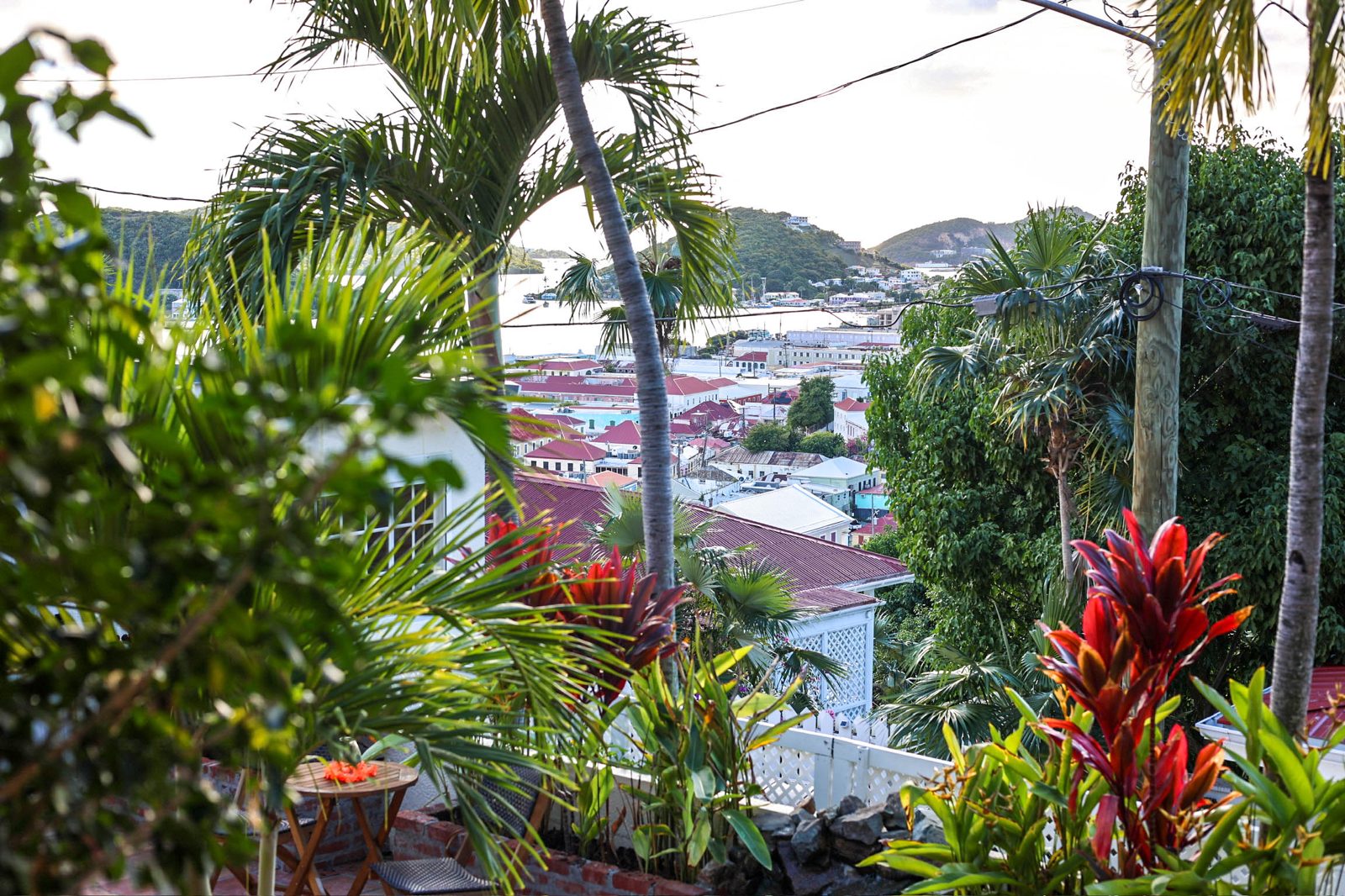
That is the case for the property this journal belongs to. The Mary Anne has six rooms in the hills above Charlotte Amalie, a rooftop pool over the harbor, and tropical grounds beside Blackbeard’s Castle and the 99 Steps. The historic district is below you and the restaurants are within reach on foot. Six rooms means the staff know exactly who is on the property. You can see the rooms on our stay page.
Safest Caribbean Island for a First Trip
If this is a first trip to the region, the shortlist narrows further, and the logic is simple: reduce the number of unfamiliar systems you have to learn at once.
A first trip to a U.S. territory means no passport, no currency conversion, no foreign carrier, no international-roaming surprise, no customs line, and no unfamiliar emergency number. Those are small frictions individually. Together they are most of what makes a new destination feel unsteady for the first two days.
For couples in particular, that matters more than a marginal difference in a crime index. We wrote a full comparison of the region for that decision in our guide to the best Caribbean island for a honeymoon, which weighs the same friction factors rather than ranking scenery.
Safest Caribbean Island: What the Rankings Leave Out
A few honest caveats, because a guide that only reassures you is not a guide.
Every island has neighborhoods. Aggregate island-level numbers hide enormous local variation, in the Caribbean exactly as they do in any American city. Where you are matters more than which island you are on.
Popular is not the same as safe. Some of the most visited islands in the region carry higher advisory levels than quieter ones. Volume of tourists tells you about marketing budgets, not risk.
Most incidents involving visitors are opportunistic and preventable. Unlocked doors, valuables left visible, late nights in unfamiliar areas, unlit roads. That is not a lecture, it is the actual pattern.
Nobody can tell you the safest Caribbean island for you specifically. A solo traveler, a family with a toddler, and a couple on a honeymoon are asking three different questions wearing the same words.
If you want the island-level detail on St. Thomas rather than the regional view, we answered that separately and at length in Is St. Thomas safe?, which covers the neighborhoods, the practical precautions, and the honest caveats in one place.
Frequently Asked Questions
What is the safest Caribbean island right now?
There is no single permanent answer, and be skeptical of anyone who gives you one without a source. Check the U.S. State Department’s current advisory level for any destination you are considering, then weigh jurisdiction, medical access, walkability, and hurricane season alongside it. For U.S. travelers, the U.S. territories score well on the first three because they remove the foreign-system problem entirely.
What are the top five safest Caribbean islands?
Different publications produce different lists, largely because they use different criteria and rarely disclose them. Rather than trusting a ranking, apply the four factors in this guide to your own trip. An island that is ideal for a two-week villa stay with a rental car may be a poor choice for a first-time couple with a week and no plans to drive.
Where in the Caribbean has the lowest crime rate?
Crime statistics across the region are collected and reported inconsistently, which is exactly why the rankings disagree with one another. We do not publish crime figures we cannot verify. The State Department advisory pages are the appropriate source, and they are updated as conditions change.
Do you need a passport to visit the U.S. Virgin Islands?
Not if you are a U.S. citizen travelling from the mainland. It is domestic travel, so no passport and no customs. Confirm current requirements at Visit USVI before you go.
Which months are safest for weather?
December through May sits outside the Atlantic hurricane season, which runs June 1 to November 30 with the peak risk in late August, September, and October. The National Hurricane Center is the authority worth checking.
Is a small hotel safer than a large resort?
Not automatically, but small properties have a structural advantage worth naming: staff recognise every guest, know who belongs on the grounds, and notice when plans change. In a walkable district, that combination removes most of the practical friction.
The Bottom Line
The search for the safest Caribbean island usually ends in a ranked list, and a ranked list is the least useful thing it could produce. The better approach is to ask what would actually have to go wrong on your trip, and how long the path back would be from each place you are considering.
Judged that way, a U.S. territory answers most of the question before you land. No passport, familiar law, familiar emergency services, a hospital, a jet airport, and a historic town you can walk home through after dinner.
If that sounds like the trip you are trying to plan, get in touch and we will help you build a week around it.