

In this guide
- Why a Caribbean Elopement Appeals to So Many Couples
- The Paperwork Problem Nobody Warns You About
- Choosing Your Island for a Caribbean Elopement
- What a Caribbean Elopement Actually Involves in the USVI
- Where to Say Your Vows on St. Thomas
- What a Caribbean Elopement Costs
- Timing Your Caribbean Elopement
- Frequently Asked Questions
- Start Planning Your Caribbean Elopement
A Caribbean elopement sounds like the simplest wedding you could possibly plan: two people, one beach, no seating chart. It usually is — but only once you have picked the right island. The difference between a ceremony you arrange in an afternoon and one that involves a foreign consulate, a translated birth certificate, and a mandatory residency stay comes down entirely to which flag is flying over the courthouse. This guide walks through how to choose, what the legal reality looks like island by island, and where to hold a ceremony small enough to feel like it belongs to just the two of you.
Why a Caribbean Elopement Appeals to So Many Couples
Eloping has quietly stopped meaning “running away” and started meaning “spending the money on the day instead of the guest list.” The Caribbean is where a great many couples land, and the reasons are practical as much as romantic.
The flights are short from most of the eastern United States. The weather is reliable in a way that European or coastal ceremonies are not. And the scenery does the decorating for you — turquoise water, colonial stonework, hillsides of bougainvillea — which means the budget goes toward photography, dinner, and a room with a view rather than toward filling a ballroom.
There is also the quieter reason. A Caribbean elopement removes the audience. Nobody is watching you say your vows except your officiant, your photographer, and the person you are marrying. Couples who dreaded the performance of a traditional wedding tend to describe that as the part they remember most.
The Paperwork Problem Nobody Warns You About
Here is the thing that catches couples by surprise. “The Caribbean” is not one legal jurisdiction. It is roughly thirty island nations and territories, each with its own marriage law, and the requirements vary wildly.
Some islands impose a residency period — you must be on the ground for two to four days before you can legally marry. Some require documents to be notarized, apostilled, or translated before you travel. Some want originals of birth certificates and, if either of you has been married before, certified divorce decrees or death certificates. A few require the ceremony to be performed by a registrar within specific hours on weekdays only.
None of that is insurmountable. But a marriage performed abroad has to be valid where you live, and the U.S. State Department’s guidance on marriage abroad makes clear that the requirements are set by local law, not by American convenience. If you are planning a Caribbean elopement on a tight timeline, the legal process should be the first thing you check, not the last.
Choosing Your Island for a Caribbean Elopement
Sort the region into three practical tiers and the decision gets much easier.
Foreign island nations — Jamaica, the Bahamas, St. Lucia, Barbados, the Dominican Republic, Turks and Caicos. Passports required, foreign marriage law, and in several cases a residency window before the ceremony. Beautiful, well-supplied with resorts, and entirely workable if you start early and follow the checklist precisely.
Non-U.S. territories — the British Virgin Islands, Aruba, Curaçao, the French islands. Same passport and foreign-filing requirements as above, sometimes with additional language or documentation steps.
The U.S. Virgin Islands — St. Thomas, St. Croix, and St. John. This is the outlier, and it is the reason so many American couples planning a Caribbean elopement end up here. The USVI is United States territory, so for U.S. citizens there is no passport requirement, no residency period, no blood test, and no re-registration when you get home. Your driver’s license gets you through the airport, and your marriage is legally recognized in your home state the moment you land.
That last tier turns a Caribbean elopement from a documentation project into something you can genuinely plan in a few weeks.
What a Caribbean Elopement Actually Involves in the USVI
The legal process in the U.S. Virgin Islands is the same across all three islands, because the territory shares a single court system. Choosing St. John over St. Croix changes your backdrop, not your paperwork.
You apply online through the USVI Superior Court before you ever leave home. The license fee is a flat $200, paid to the territory and separate from any venue or package cost. Once the court approves the application, your officiant performs the ceremony, files the signed license, and your certified copies are mailed to you.
The one genuine constraint is processing time, so file two to three weeks ahead of your travel dates rather than the week before. For the full step-by-step walkthrough — including the e-filing quirks and how to have documents emailed instead of collected at the courthouse — see our guide to getting married in the US Virgin Islands.
Where to Say Your Vows on St. Thomas
Of the three USVI islands, St. Thomas is the one most couples build a Caribbean elopement around. It has the territory’s main airport, so guests — if you invite any — arrive on a single flight. It has the cruise harbor, which matters if you are marrying during a port day. And it has Charlotte Amalie, a historic district of Danish stone warehouses, pastel storefronts, and stepped streets climbing the hillside.
Venue options fall into three groups. Large beach resorts handle volume and shared event lawns. Private villas offer seclusion but leave the coordinating to you. Boutique hotels sit in between — small enough to feel private, staffed enough that you are not chasing vendors on your wedding morning.
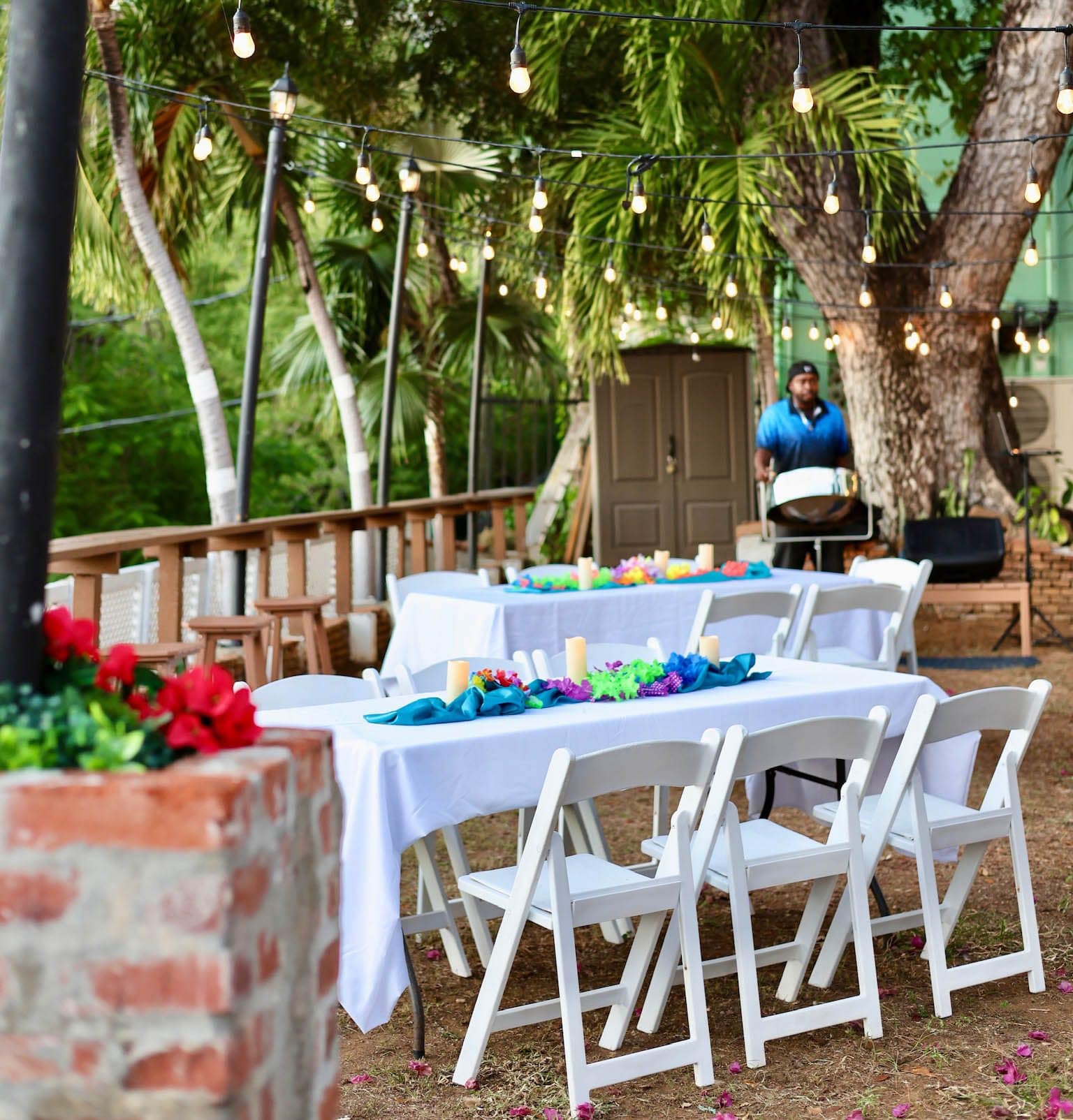
The Mary Anne Boutique Hotel sits at the top of the Charlotte Amalie hillside, next to Blackbeard’s Castle and the iconic 99 Steps. Six rooms, a rooftop pool overlooking the harbor, and tropical grounds — a property built for ceremonies of two to fifteen rather than receptions of two hundred. Vows can take place on the property itself or next door at Blackbeard’s Castle, one of the most photographed spots on the island.
Two packages map most naturally to a Caribbean elopement:
- Wedding Story — a celebration for two, with a three-night stay, a non-denominational officiant, tropical florals, a cake, champagne, and a photography session.
- Anchored in Love — built for couples arriving by cruise ship, with a day-use preparation room, officiant, staff photographer, florals, a sparkling toast, and transportation from the port and back.
Couples who want a few witnesses can size up to Island Escape or Signature Celebration, or reserve the property outright: all six rooms, the rooftop pool, the game lawn, and a dedicated on-site host for up to 15 guests.
What a Caribbean Elopement Costs
Cost is where eloping earns its reputation, because you are paying for an experience rather than a headcount. Two figures at The Mary Anne are fixed and easy to plan around from the start: the $200 USVI marriage license, paid directly to the territory, and an 18% service fee applied to the package.
Package pricing itself is shared on inquiry rather than posted as a flat rate, because couples build the day differently. A flower arch, a private chef dinner, upgraded photography, hair and makeup, a sunset sail, or extra nights all sit on top of the base tier. The most reliable way to budget a Caribbean elopement is to choose the tier that matches your guest count — usually zero to a handful — and then add only the pieces you will actually remember a decade from now.
Timing Your Caribbean Elopement
Temperatures across the U.S. Virgin Islands stay in a narrow band, roughly 77 to 85°F, so there is no genuinely bad month. What changes is crowding, rates, and rain probability.
December through April is dry season: the best weather, the highest rates, the fullest calendar. Book early for a specific date.
May, June, and November are the shoulder months and, for a ceremony this small, often the smartest window. The weather holds, the island is quieter, and availability is far better.
August through October falls in hurricane season. Plenty of couples marry successfully then, but build flexibility into your plans and check the current outlook from Visit USVI before committing deposits.
One local scheduling note: cruise traffic fills Charlotte Amalie between roughly 8am and 4pm in high season. A late-afternoon ceremony gives you a quieter town and considerably better light.
Frequently Asked Questions
Do we need passports for a Caribbean elopement?
It depends entirely on the island. Foreign nations and non-U.S. territories require them. The U.S. Virgin Islands does not for U.S. citizens — a valid driver’s license is sufficient. You would only need a passport there if you planned to cross into the neighboring British Virgin Islands during the trip.
Which Caribbean island is easiest to elope on?
For American couples, the U.S. Virgin Islands, by a wide margin. There is no passport requirement, no residency period, no blood test, one online application, and no need to re-register the marriage at home.
How far in advance should we plan?
In the USVI, filing two to three weeks ahead of travel is comfortable. Elsewhere in the Caribbean, allow a month or more for documents to be notarized or apostilled, and check whether the island imposes a residency period before the ceremony.
Can we elope during a cruise stop?
Yes. The Mary Anne’s Anchored in Love package is built around a port day, with a day-use preparation room, transportation from the harbor, and a timeline designed so you are back on board with room to spare.
How many people can come to an elopement?
As many or as few as you like — most couples bring nobody or a witness or two. If you want a small group present, The Mary Anne’s full property buyout hosts up to 15 guests.
Is a Caribbean elopement cheaper than a wedding at home?
Frequently, yes, because the guest count is what drives most wedding budgets. You are paying for travel, a venue, an officiant, and photography rather than catering for a hundred people.
Start Planning Your Caribbean Elopement
The whole appeal of eloping is that the day belongs to the two of you, and the right island protects that instead of complicating it. Choose the U.S. Virgin Islands and the administration shrinks to one online form, one flat fee, and a domestic flight.
If a small hillside ceremony above Charlotte Amalie Harbor sounds like your version of it, read our detailed guide to planning a St. Thomas elopement, view our wedding packages, or contact our team to check your date.