

In this guide
- What a Caribbean Destination Wedding Actually Involves
- Start With the Marriage Law, Not the Venue
- The Guest Math Nobody Runs First
- What a Caribbean Destination Wedding Really Costs
- A Realistic Caribbean Destination Wedding Timeline
- Why the U.S. Virgin Islands Simplifies a Caribbean Destination Wedding
- Where a Small Caribbean Destination Wedding Fits at The Mary Anne
- Caribbean Destination Wedding FAQ
- Ready to Talk Dates?
A caribbean destination wedding is sold to you as the easy option (fewer guests, one location, somebody else handling the flowers), and for a lot of couples it genuinely is easier than a wedding at home. But the version in the brochure skips the parts that actually take work: a foreign government’s marriage law, thirty people booking their own flights, a currency you don’t use, and a vendor team you will meet for the first time two days before the ceremony. None of that is a reason not to do it. It is a reason to know what you are signing up for before you put down a deposit.
This is the planning-reality guide: what the process really involves, what drives the cost, and how long it takes.
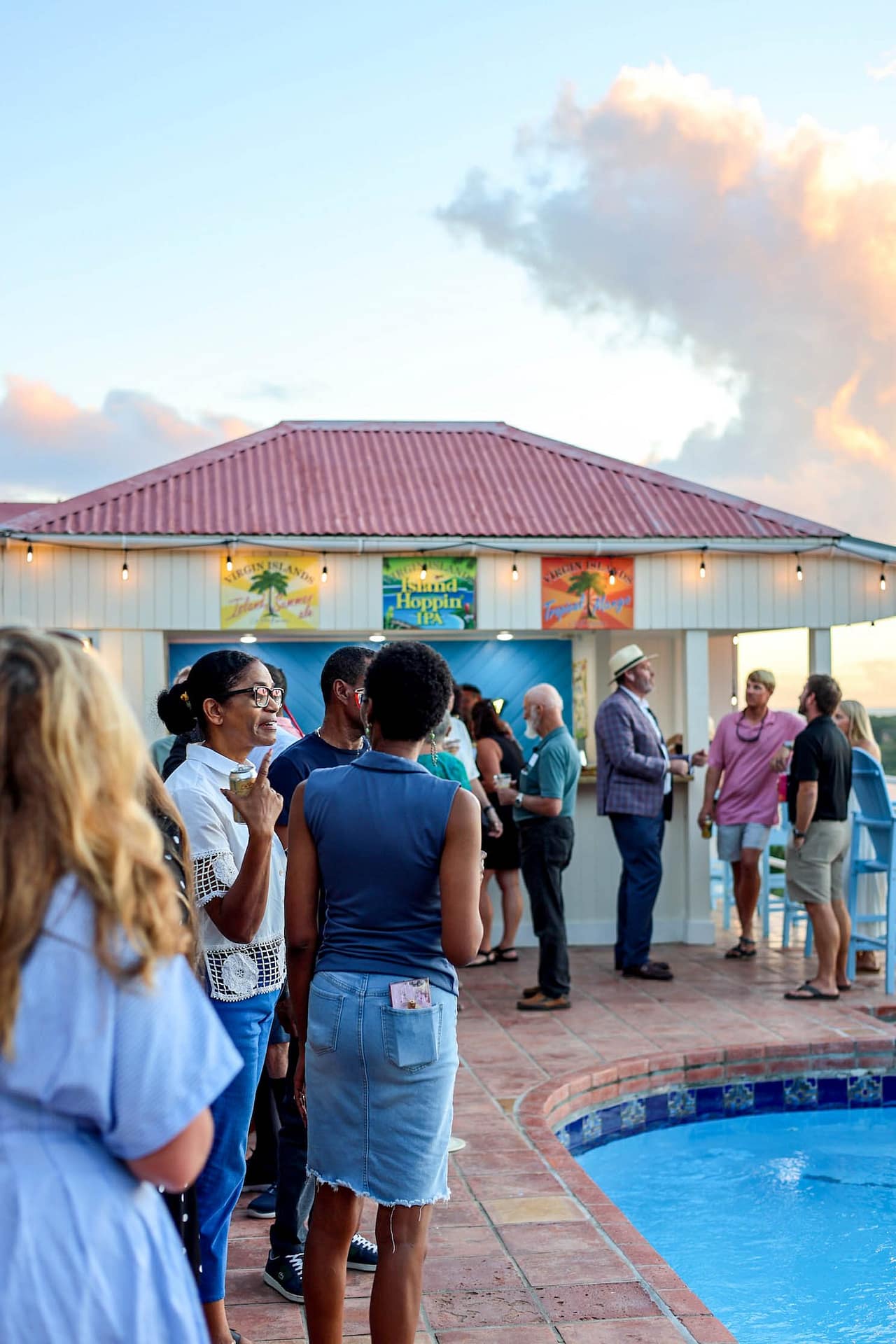
What a Caribbean Destination Wedding Actually Involves
Strip away the scenery and a caribbean destination wedding is four projects running at once.
The legal one. Getting a marriage that is valid where you’re standing and recognized when you get home.
The logistical one. Moving your people across water, on their own budgets, on their own schedules.
The vendor one. Hiring a photographer, officiant, florist, and caterer you cannot meet in person until the week of.
The hospitality one. Housing everyone somewhere that suits a group rather than a couple, and feeding them for three days rather than one evening.
Couples who find the process painless are usually the ones who chose a destination where all four of those are simple, and a property that runs three of them for them. Couples who find it exhausting usually picked the view first.
Start With the Marriage Law, Not the Venue
The single most expensive planning mistake is choosing the property before reading the marriage requirements.
“The Caribbean” is not one jurisdiction. It is roughly thirty island nations and territories, each with its own marriage statute. Some impose a residency period, meaning you must be physically on the island for two to four days before you’re allowed to marry. Some require birth certificates and divorce decrees to be notarized, apostilled, or translated before you leave home, a process that can take weeks and cannot be rushed from a hotel lobby. Some restrict who may officiate, or hold ceremonies to weekday business hours only. And a marriage performed abroad still has to be recognized in your home state; the U.S. State Department’s guidance on marriage abroad is direct that those requirements are set by local law, not by what is convenient for visiting Americans.
So the first question in any caribbean destination wedding is not “which beach.” It is: what does this island require of us, how far in advance, and in what form? Answer that and half the shortlist disappears on its own.
Two shortcuts are worth knowing. First, some couples handle the legal marriage at home and treat the island ceremony as a symbolic one. That is perfectly valid, and it removes the paperwork entirely. Second, U.S. territories operate under U.S. law, which means no apostilles, no translation, no foreign consulate, and no passport for American citizens. The U.S. Virgin Islands is the clearest example, and it is why so much of the practical advice in this guide keeps landing there.
The Guest Math Nobody Runs First
Here is the number that surprises people: a destination wedding does not have a guest list, it has an attendance rate.
Invite eighty people to an island and you will typically host a fraction of them, because every guest is quietly deciding whether they can spend four figures and take a week off. That is not a failure of your wedding. It is the mechanism that makes a caribbean destination wedding intimate in the first place. The mistake is planning for eighty, contracting for eighty, and then hosting twenty-two in a ballroom built for two hundred.
Plan for the number who will actually come, and the whole event changes shape. Twelve to twenty guests is not a compromised wedding. It is a different and frankly better one. It fits a private property instead of a resort block. It means one long table rather than a seating chart. It means you can talk to everyone.
Practical things that move your attendance rate:
- Flight legs. One connection is fine. Two connections plus a ferry loses people.
- Passports. Roughly half of Americans don’t hold one. A destination that doesn’t require one removes a $165 barrier and a six-week wait.
- Notice. Nine to twelve months is the working minimum for guests to book flights at a sane price.
- Total cost to attend. Airfare plus lodging plus time off. If that number is over about $1,500 per person, expect regrets.
What a Caribbean Destination Wedding Really Costs
Cost conversations get confusing because two very different models get quoted side by side.
The all-inclusive resort model bundles a package price that looks low, then adds per-person charges for anything above the base count, an outside-vendor fee if you don’t use their photographer, and a service charge on top. It scales well to sixty guests and poorly to fifteen.
The private property model prices the space and the stay rather than the head count. For a small group it is usually the better value, and it comes with something the resort model can’t sell you: nobody else is there.
Either way, the line items that actually move a caribbean destination wedding budget are consistent:
- Your guests’ travel. The largest cost in the whole event, and one you don’t pay.
- Lodging for the couple and the wedding party, typically three nights minimum.
- The ceremony itself. Officiant, florals, photography, cake, coordination.
- Food and drink, which quietly becomes multi-day: a welcome dinner, the reception, a farewell breakfast.
- Government fees. In the USVI the marriage license is $200, paid directly to the territory.
- Service charge. At The Mary Anne that is 18%, applied to the package.
Ask any property for the all-in number including service charge and license, not the headline rate. The gap between those two figures is where destination wedding budgets go to die.
A Realistic Caribbean Destination Wedding Timeline
Twelve months is comfortable. Six is workable. Under three is an elopement, and that is fine. It is just a different plan.
12–10 months out. Choose the island based on marriage law and flight access. Hold the date with the property. Decide your real guest number.
10–8 months out. Send save-the-dates with flight guidance, because your guests are booking airfare long before they RSVP. Book photography.
8–5 months out. Lock the vendor team. Order and, if the island requires it, notarize or apostille documents. Reserve a room block or the whole property.
5–2 months out. Menus, florals, the ceremony order. Confirm transfers from the airport or the cruise pier.
2 months to the week of. File the marriage license application. In the USVI this happens through the Virgin Islands Superior Court and can be done online rather than in person. Arrive a few days early for a rehearsal dinner and a legitimately relaxed final forty-eight hours.
The rhythm of a caribbean destination wedding is front-loaded: the decisions that matter all get made in the first three months, and the last month is mostly confirmations.
Why the U.S. Virgin Islands Simplifies a Caribbean Destination Wedding
Most of the friction described above comes from crossing an international border. The USVI removes that border.
For U.S. citizens there is no passport requirement. A driver’s license gets you in, exactly as it would for a flight to Florida. The territory operates under U.S. law and the U.S. dollar, cell phones work on domestic plans, and the marriage license process runs through a U.S. court that accepts online applications. There is no residency waiting period to sit through before you can marry. And St. Thomas has the only major jet airport in the territory, so most guests fly in on a single connection, per Visit USVI.
Then the practical detail that decides a lot of caribbean destination wedding plans: your marriage is a domestic one. No apostille, no translation, no consular step, no wondering whether your home state will recognize the certificate. It already does.
That is not an argument that the USVI is the most beautiful island in the Caribbean. That is a matter of taste, and there is no shortage of contenders. It is an argument that it is the least complicated one to get legally married on if you are American.
Where a Small Caribbean Destination Wedding Fits at The Mary Anne
The Mary Anne is a six-room boutique hotel on the hillside above Charlotte Amalie, next to Blackbeard’s Castle and the 99 Steps, with a rooftop pool over the harbor and tropical grounds below. It is not a resort and does not pretend to be one. It is the private-property version of a caribbean destination wedding.
That shapes who it suits. Couples marrying alone or with a handful of people, wedding parties in the twelve-to-twenty range, and cruise passengers who want a real ceremony inside a port day rather than a rushed one on the pier. The full property can be reserved for up to 15 guests — all six rooms, the rooftop pool, the game lawn, the kitchen, and a dedicated on-site host. That is the closest thing to having the island to yourselves without renting a villa and staffing it.
The packages run from Anchored in Love, built for cruise guests with no overnight stay, through Wedding Story for the couple, Island Escape for a small wedding party, and Signature Celebration for the full multi-room experience. Each one includes a non-denominational officiant, tropical florals, photography, and concierge coordination. Package pricing is shared on inquiry; the $200 territory marriage license and the 18% service fee are separate and always quoted openly.
If you want the ceremony detail island by island, our guide to a St. Thomas destination wedding covers the venue side, and if your guest list is really just the two of you, read Caribbean elopement instead. Different plan, much shorter timeline.
Caribbean Destination Wedding FAQ
How far in advance should we book a caribbean destination wedding?
Nine to twelve months if you want guests, mainly so they can buy airfare at a reasonable price. Six months is workable for a small group. Under three months, plan it as an elopement or a very small ceremony.
Do we need a passport?
Not for the U.S. Virgin Islands if you’re a U.S. citizen. A valid driver’s license is sufficient. Most other Caribbean destinations do require one, and so does a side trip to the British Virgin Islands.
Is a Caribbean marriage legal back home?
It generally is, provided you followed local law correctly and can produce a certified copy. A USVI marriage avoids the question entirely, because it is a U.S. marriage.
How many guests actually come to a destination wedding?
Far fewer than you invite. Plan around the people who will realistically travel rather than the full invitation list, and choose a property sized for that number.
Can cruise passengers get married during a port day?
Yes. That’s exactly what the Anchored in Love package is built for: a day-use room for preparations, the ceremony, transportation from the pier, and back aboard with time to spare.
Is a resort or a private property better for a small wedding?
For fifteen guests, a private property is usually both better value and a better experience. Resorts price and stage around large groups, and a small wedding in a large venue tends to feel like one.
Ready to Talk Dates?
A caribbean destination wedding stops being abstract the moment you have a date, a guest number, and an island. If those three are close to settled, tell us what you’re imagining — we’ll tell you honestly whether The Mary Anne is the right fit, and what it would look like if it is.