

In this guide
- How to Choose the Best Area to Stay in St. Thomas
- Charlotte Amalie: The Best Area to Stay in St. Thomas for Character and Walkability
- The East End: Red Hook, Sapphire, and Ferry Access to St. John
- The South Shore: Frenchman’s Bay and Beachfront Resorts
- The North Side: Magens Bay and the Quiet Hills
- West End and Beyond: Where Fewer Travelers Base Themselves
- Quick Comparison: Matching the Neighborhood to Your Trip
- Why the Historic District Wins for Most Travelers
- When to Visit St. Thomas
- Frequently Asked Questions
- Book the Right Base for Your Trip
Choosing the best area to stay in St. Thomas matters more than choosing the hotel itself, because this small island is really a handful of very different neighborhoods stitched together by winding hillside roads. Where you base yourself decides how your days feel — whether you wake to a working harbor and centuries of stonework, a quiet cove at the end of a lane, or a resort strip built around a single beach. This guide walks the island neighborhood by neighborhood, honestly, so you can match the right base to the trip you actually want.
How to Choose the Best Area to Stay in St. Thomas
St. Thomas is only about thirteen miles long, yet driving from one end to the other can take the better part of an hour on steep, switchbacking roads. That single fact shapes everything. The best area to stay in St. Thomas for you depends less on which beach photographs best and more on how you plan to spend your time and how far you want to travel for dinner.
A few questions sort most travelers quickly. Do you want to walk out the door into shops, restaurants, and history, or do you want to close a gate behind you and hear nothing but the water? Are you here to explore the whole island, or to plant yourself in one spot and barely move? Do harbor and hillside views matter more to you than a stretch of sand a few steps from your room? Answer those honestly and the map below narrows fast.
Charlotte Amalie: The Best Area to Stay in St. Thomas for Character and Walkability
For travelers who want a real sense of place, Charlotte Amalie is the best area to stay in St. Thomas — full stop. The island’s capital is one of the oldest towns in the Western Hemisphere, and its Historic District climbs the hillside above a deep natural harbor in a lattice of Danish colonial streets, ship-ballast-brick lanes, and stone step streets like the famous 99 Steps.
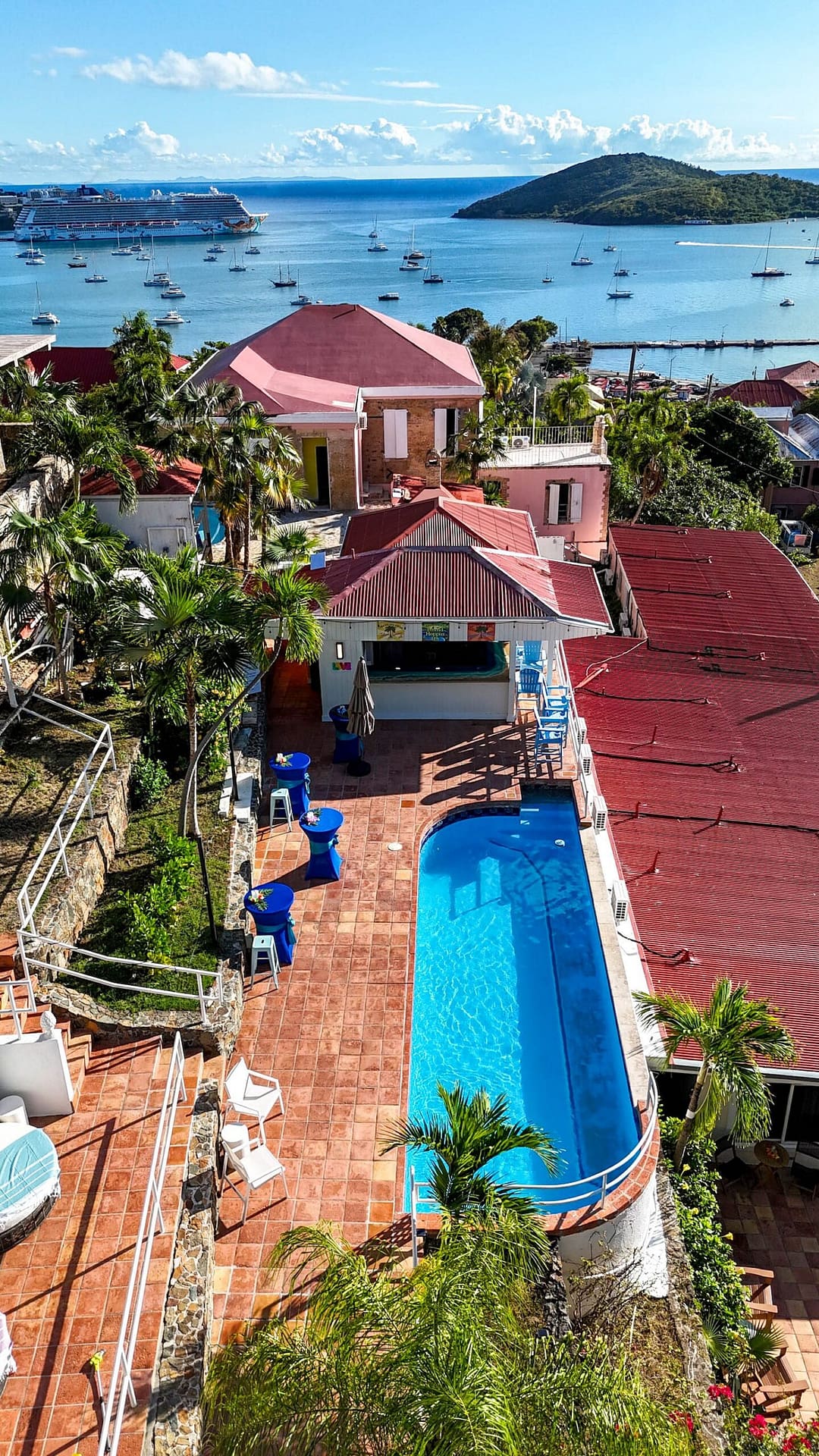
Staying here means the island’s most walkable concentration of restaurants, shops, and history sits just outside your door. Mornings open over the harbor; evenings you can stroll downhill into centuries-old merchant buildings for dinner rather than booking a taxi. The views are the other draw — from the upper hillside, the whole harbor and the cruise ships and the sunset spread out beneath you, a vantage the beach neighborhoods simply do not have.
This is where The Mary Anne Boutique Hotel sits. Six rooms on the historic hillside beside Blackbeard’s Castle and the 99 Steps, with a rooftop pool over the harbor, mahogany interiors, and stone that has watched over the water for generations. If your idea of the best area to stay in St. Thomas is somewhere with genuine history and everything within walking distance, this is that neighborhood, and this is the property built for it. See the rooms to picture it.
The trade-off is straightforward: Charlotte Amalie is a town, not a beach. The nearest swimming beaches are a short drive away. For most travelers that is a fair exchange for character, views, and walkability you cannot get anywhere else on the island.
The East End: Red Hook, Sapphire, and Ferry Access to St. John
The East End is the busy, convenient corner of the island. Red Hook is its hub — a marina town with restaurants, bars, and the ferry dock that carries you across to St. John in about twenty minutes. If day-tripping to the national-park beaches of St. John is high on your list, this is a strong base.
The East End also holds some of the island’s calmer, family-friendly beaches and a cluster of condos and mid-size properties. It feels livelier and more built-up than the quiet coves, with easy dining and provisioning. The trade-off is distance: you are as far from Charlotte Amalie and the airport as the island allows, so factor the drive into any plans on the other end.
The South Shore: Frenchman’s Bay and Beachfront Resorts
The South Shore, running from just outside Charlotte Amalie toward the southeast, is where most of the island’s larger beachfront resorts sit. This is the best area to stay in St. Thomas for travelers who want a classic resort rhythm — sand a short walk from the room, pools and dining on site, and a lounger you never have to leave.
Frenchman’s Bay and the coastline near it put you close to the airport and a reasonable drive from town, with calm, swimmable water. If your ideal trip is one property, one beach, and few decisions, the South Shore delivers it reliably. The honest caveat is scale: these are larger properties, so the beach, the sunset deck, and the restaurants are shared with a lot of other guests. For a deeper look at that resort-versus-boutique question, our guide to St. Thomas honeymoon resorts breaks it down.
The North Side: Magens Bay and the Quiet Hills
The North Side is the island’s postcard. Magens Bay — a long, calm, palm-lined arc regularly named among the Caribbean’s finest — anchors this coast, along with green hills and a scattering of villas and small inns. It is the best area to stay in St. Thomas for travelers chasing seclusion and scenery over nightlife and dining.
Expect quiet. The North Side is residential and lightly developed, so you will drive for most meals and there is little to walk to after dark. In exchange you get some of the island’s most beautiful beaches and hillside outlooks, and a genuinely peaceful base. It suits villa renters and couples who want the world to go quiet more than they want a restaurant scene.
West End and Beyond: Where Fewer Travelers Base Themselves
The island’s western reaches are the least-trafficked by visitors — more local neighborhoods, fewer hotels, and a longer haul to the main attractions. Travelers occasionally land here for a specific villa or a budget find, but for a first trip it rarely earns a spot as the best area to stay in St. Thomas. Unless something specific pulls you west, the neighborhoods above will serve you better.
Quick Comparison: Matching the Neighborhood to Your Trip
To pull it together, here is the short version of where each type of traveler tends to land:
- Want history, walkable dining, and harbor views? Charlotte Amalie Historic District — character and walkability the beach zones can’t match.
- Day-tripping to St. John or want a lively marina scene? The East End around Red Hook.
- Classic beachfront resort, sand outside your door? The South Shore near Frenchman’s Bay.
- Seclusion, top-tier beaches, and quiet hills? The North Side near Magens Bay.
- A specific villa or budget stay off the tourist track? The West End.
There is no single right answer — only the best area to stay in St. Thomas for the way you want the week to feel. Many travelers even split it: a few nights in town for character and views, a few nights beachside.
Why the Historic District Wins for Most Travelers
If you are still deciding, the historic district tips the scale for one reason the others cannot copy: location does double duty. You get the views and the walkability and the sense of place, all at once, without trading one for another. A resort hands you a beach but a lobby that could be anywhere; a North Side villa hands you quiet but a drive for every meal. Charlotte Amalie hands you an actual place — one of the oldest towns in the hemisphere — with the harbor at your feet and dinner downhill.
That is the case for basing yourself at a small hotel on the hillside. The Mary Anne leans all the way into it: a rooftop pool over the harbor, gardens through the grounds, and a staff small enough that your stay is personal by default. For couples who want the whole property to themselves, it can be reserved as a full buyout — all six rooms, the rooftop pool, the game lawn, and a dedicated on-site host for up to 15 guests. Rates and availability are shared on inquiry, shaped around your dates.
When to Visit St. Thomas
Neighborhood aside, timing shapes the trip. St. Thomas holds between roughly 77 and 85°F year-round, so the calendar is about crowds and rates more than weather.
December through April is the dry-season peak — reliably gorgeous, busiest, and priced accordingly. The shoulder months of May, June, and November are the value sweet spot: the same postcard weather with thinner crowds and softer rates across every neighborhood. Late summer into fall falls within hurricane season, quietest and cheapest of all, best for flexible travelers who carry travel insurance. The authoritative event calendar lives with the Visit USVI tourism board, and if St. John is on your radar, Virgin Islands National Park covers two-thirds of that island.
Whichever season you pick, remember that small properties fill first — a six-room hotel books out further ahead than a large resort, especially around holidays and wedding season.
Frequently Asked Questions
What is the best area to stay in St. Thomas for first-time visitors?
For a first trip, Charlotte Amalie’s Historic District is hard to beat — it is the most walkable neighborhood, closest to the island’s history and dining, and it delivers harbor and hillside views the beach zones lack. Travelers who prioritize a beach outside their door often choose the South Shore instead.
Where should I stay in St. Thomas without a car?
The Historic District of Charlotte Amalie is the easiest car-free base, with restaurants, shops, and sights within walking distance and taxis on hand for the beaches. Most other neighborhoods really do assume you will drive.
Is Charlotte Amalie a good place to stay in St. Thomas?
Yes — especially if you value character, walkability, and views. It is the island’s capital and historic heart, with the widest choice of dining and the most walkable streets. The nearest swimming beaches are a short drive, which most travelers find a fair trade.
Which area of St. Thomas has the best beaches?
Magens Bay on the North Side is the most celebrated beach, while the South Shore and East End hold calm, swimmable coves. Charlotte Amalie is the town base rather than a beach base, with beaches a short drive away.
How many days should I spend in St. Thomas?
Most travelers find three to five nights ideal — enough to settle into one neighborhood, take a day trip to St. John, and still relax. Splitting nights between town and beach is a popular way to see both sides of the island.
Do I need a passport to visit St. Thomas?
No. St. Thomas is a U.S. territory, so U.S. citizens travel with a valid driver’s license. A passport is only needed to continue on to the British Virgin Islands.
Book the Right Base for Your Trip
The best area to stay in St. Thomas is the one that fits the week you are picturing — beach rhythm on the South Shore, ferry access on the East End, quiet on the North Side, or history and harbor views in Charlotte Amalie. If it is the last of those, The Mary Anne Boutique Hotel was built for exactly this neighborhood. See rooms and availability, or contact our team to plan your stay around your dates.